Historical Cambria Walking Tour
Step back in time and take a historic tour of Cambria's East Village.
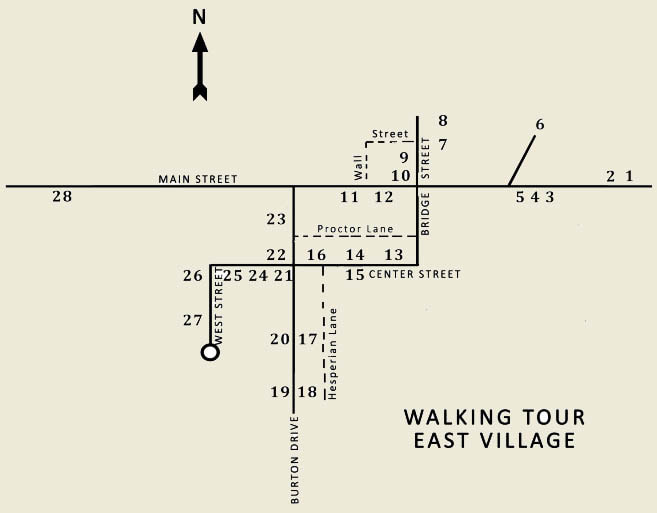
Whether you are a local or a visitor, Cambria's fascinating history is alive and well in East Village. Discover it by just taking a walk around town. Here's a brief guide prepared by Cambria's native-born rancher/historian, Dawn Dunlap. This tour begins at the eastern edge, and earliest area, of the village.
1 Kaetzel/Williams House
Current Name: Fog's End
2735 Main St.
In 1865, Philip and Sarah Scott Kaetzel settled on 150 acres on a busy road outside a mining boom town later named Cambria. Philip, a master wheelwright, had a wagon and blacksmith shop constructed near the road and built a modest home and barn for their dairy herd. In 1880, the Kaetzels moved their house across the street and replaced it with a grand new home. In 1882, Philip served as our County Treasurer and subsequently managed the Cambria branch of the Commercial Bank of San Luis Obispo. Sarah died in 1895; a decade later Philip moved to San Luis Obispo. In 1910, Antone and Rosa Machado Williams bought the property and established a larger dairy, grew beans and alfalfa and reared three sons. The Williams family owned the house for nearly 90 years.
2 Music House
Currently: Private Residence
2581 Main St.
The structure was among the first built in Cambria. George Grant and George Lull and their partners moved their mercantile operation from the bluff near the mouth of San Simeon Creek to this location in 1865. Mr. Lull lived on the second story above the new store. It was converted into a private residence in the early 1870s; and was the Music family residence for 60 years.
3 Mandersheid/Franklin/Smithers House
Current Name: The Olallieberry Inn
2476 Main St.
Built in 1875 for Otto and Carl Mandersheid, Prussian-born and trained apothecaries, this building was later home to prominent Cambria families; Benjamin Hubes and Blanche Music Franklin, an attorney and owner of a theatre, saloon and store in Cambria; and Amos and Ida Terrill Smithers, who was the Bank of Cambria's president. She was William and Eunice Leffingwell's granddaughter.
4 Shaw/Steiner House
Current Name: The Cambrian Newspaper
2442 Main St.
The home was built after 1914 by the town dentist, Dr. Harry and Mrs. Zoe Shaw. George and Anna Gamboni Steiner bought the house in 1927. He was appointed a local judge in 1951. It housed other businesses before it became the newspaper office.
5 Utley/Leffingwell/Goodall House
Currently: Private Residence
2420 Main St.
This structure was built in 1875 by Merit Utley, a rancher, miner and owner of the Cambria Meat Market. Later, the residence was owned by Joseph "Bob" Warren, Jr., and William and May Woods Leffingwell, Jr. The estate of their daughter, Anna Bergagnini, sold it to Lloyd and Arminta Varney Gregg whose daughter, Helen Gregg Goodall, lived in the house and reared her children there for 30 years. Mrs. Goodall planted many of the flowers still thriving in the yard today.
6 Santa Rosa Chapel and Cemetery
Current Name: Old Santa Rosa Chapel and Cemetery
2353 Main St.
The chapel was built for the local Roman Catholic community by Henry Williams and was the first church built in San Luis Obispo County after its establishment in 1850. It served the community for 91 years. Guests of William Randolph Hearst, including Marion Davies, Gary Cooper and Bing Crosby, attended Mass there. The cemetery is the final resting place of many Cambria pioneers, among them the Phelans, Pereiras, Cantuas, Sotos and Fiscalinis. A committee of local Cambrians had it placed on the National Register of Historic Places in 1982, restored it, and maintains the chapel and its adjacent grounds.
7 Williams/Thorndyke/Bright House
Current Name:
4286 Bridge St.
Henry Williams, a prominent local carpenter, built this home as his residence in 1877. He and his wife Sallie lived here for 20 years. In 1914, Captain Lorin Thorndyke (first lighthouse keeper at Piedras Blancas) and his wife, Margaret Jarmon Thorndyke, bought the house and made it their home until their respective deaths in 1917 and 1929. The Bright family bought it, and Miss Mabel Bright lived here for nearly 50 years.
8 First Presbyterian Church
Current Name: Living Waters Christian Fellowship; The Bridge Street Inn
4314 Bridge St.
Henry Williams and Merritt Trace and his son, Verne, built this church for the local Presbyterian community in 1876. The bell tower and new entrance were added in 1906. The church served Presbyterians for 91 years, with visiting governors and state legislators occasionally attending services. President and Mrs. Calvin Coolidge, guests of William Randolph Hearst, attended Sunday service March 2, 1930. It served as the First Baptist Church from 1967- 1987 and was subsequently the Vineyard Christian Fellowship Church; the manse was converted to a hostel.
9 Lyons House
Currently: Private Residence
4281 Bridge St.
Jeremiah (Jerry) Johnson came to the area in 1859, and by 1863 established himself near the present day intersection of Main and Bridge Street. He later lived with his English-born wife, Elizabeth, in a small house built in 1867 up the road on this parcel where Wall Street intersects. When that house was sold and moved in 1922, a fine new home was built for William and Anna Marquart Lyons, who owned and operated a general merchandise store on Main Street for forty years. Their son and daughter in law, Wilfred and Hazel Kennett Lyons, moved here from their original home on Center Street. The community’s beloved residents both worked for decades at Soto’s Market and established the lovely gardens which their family still maintains. Wilfred was Cambria’s preeminent historian emeritus.
10 Bank of Cambria and Bank of America
Current Name: The Vault Gallery
2255 Main St.
The Bank of Cambria opened here in 1928 with a distinguished local Board of Directors. After unfortunate investments in 1931 and the subsequent closure of banks nationwide in 1933, the Bank of Cambria closed and was later sold to the Bank of America. The Bank of America reopened the doors that same year and conducted business here for 45 years.
11 Cambria Meat Market & Grocery - J.M. Soto
Current Name: Soto's Marketplace
2244 Main St.
The present stucco store was built for Joaquin and Agnes Maggetti Soto by Roland Houtz in 1939. Three generations of the Soto family operated the store at this location for 72 years. The store had operated at this location from 1919 to 1939 in a wooden structure which was built in 1889. The Soto family sold the present business in 1991.
12 Camozzi's Bar and Hotel
Current Name: Mozzi's Saloon2262 Main St.
In 1922, Clifford Davis built the structure for Adriano and Rosa Filipponi Camozzi for a total cost of $15,000. Initially, it was a two-story hotel, card parlor, pool hall and barbershop complex. Because of the Volstead Act of 1920, also known as Prohibition, no alcohol was served between 1920 and 1934. The Camozzi family owned and operated the bar and hotel for 43 years.
13 The Bucket of Blood
Current Name: Evans and Gerst Antiques
4111 Bridge St.
The structure was built in 1893 for John McCain and remained McCain's saloon for about a decade. In turn, it became Eubank's Blacksmith, the Cambria Courier newspaper office, Bank of Cambria, Rip and Riley's Restaurant and Bar, the studio of renowned California artist Phil Paradise, and finally a popular recording studio. Its familiar moniker, The Bucket of Blood, was given the structure during the 1940s. Brothers James and William Bianchini and their heirs and assigns owned the structure for 80 years.
14 Maggetti House
Current Name: Hidden Gate Antiques
2261 Center St.
Built by James Erdman in the early 1870s, it became the home of one of Cambria's first physicians, Dr. Russell Parkhurst and his wife, Mary. Louis and Candelara "Lala" Galbraith Maggetti bought the house in 1894 and raised six children here – building a second story in 1900 for their four daughters. Louis Maggetti operated a leather goods and shoe repair shop in Cambria for 40 years, and three generations of the Maggetti family owned the home for 81 years. Marjorie Meacham Delyser, the owner in 1978, rescued it from deterioration, and subsequently rented it to several businesses. In 2014, the Cambria Historical Society purchased the house for future use as an annex to the adjacent museum.
15 Rothschild/Gans/Warren Home Sites
Current Name: Greenspace Creekside Reserve and Chinese Temple
2264 Center St.
After initial ownership by George W. Proctor and George S. Davis and their spouses, the property changed hands many times. Noteworthy was the July, 1873 purchase by Drury W. James, co owner of the Paso Robles Inn, who also ran the La Panza Ranch east of Templeton, and who was visited there without incident by his nephew, Jesse James. In 1873 the property was purchased by George Rothschild and his bride, Bertha. He was in the mercantile business with Abram Gans on Main Street, and when he took his life, the widow sold the house to another merchant, Samuel Frank. Frank in turn sold the property to Abram and Johanna Gans in 1877, who lived there until the 1890s; Lee Street (now Burton Drive) was named for their son. Mrs. Johanna Gans moved to San Francisco in the late 1890s. She allowed the local Chinese community to construct an association hall, a temple, two laundries, several small houses and festival facilities along the creek bank. The Gans family owned the property for over 40 years. In 1916, William and Lily Messic Warren bought the property and tore down all of the Chinese built structures except the temple. Wishing to make a larger home for his family, William added the temple structure to the 1873 Rothschild House, as well as to a structure which originally faced Main Street that served as a general store and the town’s first high school. Three generations of the Warren family owned and occupied the property for 80 years. Greenspace, the Cambria Land Trust, purchased the house and property in 1999.
16 Guthrie/Bianchini House
Current Name: Cambria Historical Museum
2251 Center St.
The original part of the house was built in 1870. Thomas and Rachel Clendinen were the first recorded owners of the property; a succession of owners followed. In 1882 Benjamin Hubes Franklin enlarged the house and subsequently sold it to Samuel and Sarah Woods Guthrie. Guthrie was an employee and eventually a partner in the Grant and Lull Store. Mrs. Guthrie was reared on a farm on Santa Rosa Creek Road. The Guthries enjoyed one of the town’s most elegantly furnished homes for 20 years before Samuel’s death in 1905. In 1914, Sarah Guthrie sold it to Eugenio and Louisa Bezzini Bianchini. He was a rancher and dairyman, mine owner, distributor of illegal Canadian whiskey, and master of the barbecue. The Bianchini family owned the house for 87 years. In 1980, a citizens committee had the house placed on the National Register of Historic Places. The Cambria Historical Society purchased the property and deteriorating structure in 2001, reconstructed and renovated it; and in 2008, opened it as the Cambria Historical Museum.
17 Bonomi House
Current Name: Wine: Taste
4056 Burton Dr.
This stucco house was built on Lee Street for Angelo and Katina “Mary” Bonomi by contractor George Loorz, who was also overseeing construction on William Randolph Hearst’s hilltop home and the new Cambria Union Elementary School on Main Street. The Bonomis insisted that the house be an exact replica of the Milton Mayfield house on Center Street. After retiring from local ranching and dairying, they settled here permanently in 1950 until Angelo’s death.
18 Rigdon House
Current Name: The Burton Inn
4022 Burton Dr.
The Bright family originally built the structure in 1880. In 1893, the house was sold to local teacher and carpenter, Merritt Trace. Trace and his son, Verne, made extensive renovations to the original structure and sold it in 1905 to Rufus and Indiana (“India”) Scott Rigdon. Rigdon was the town’s Notary Public and Justice of the Peace. He was also the owner of a ranch northwest of town that is now part of the Fiscalini Ranch Preserve. (The Rigdons’ house was famous for having the first indoor bathtub in Cambria.) Their son, Elmer Scott Rigdon, was elected to the California State Assembly in 1912 and the California State Senate two years later. He introduced the bill in 1917 to build the Coast Highway between Carmel and San Simeon. Subsequent owners continued to reside in and renovate the house. In the late 1960s it was converted into a restaurant, and then in the 1970s into an inn by restaurateurs, Bryan and Sylvia Hume.
19 Mora/Lowell House
Current Name: The Brambles Dinner House
4005 Burton Dr.
The original three-bedroom home was built in the mid-1870s. From 1895 to 1905, it was the home of Raphael and Josephine Vasquez Mora and their family; the large lot behind the home was the site of livestock holding pens and slaughter house. Raphael was a partner in a very successful butcher shop on Bridge Street. The house served as a residence and medical clinic for Dr. Frank and Mrs. Frances Lowell for over a decade. In 1955 Holland and Norma Vaughn bought the house and remodeled it as a restaurant, and coined the name "Brambles by the Bridge". In 1964 the restaurant was purchased by Brian and Sylvia Hume, who added onto the structure. The Brambles achieved statewide renown for its antique furnishings and delicious food during their twenty year ownership. Nick and Debbie Kaperonis carried on the tradition.
20 Darke/Van Gorden/ Squibb House
Current Name: The Squibb House
4063 Burton Dr.
This gracious home was built in 1877 for Frederick and Agnes Woods Darke and their eight children. Mr. Darke taught at the original Hesperian School for 12 years. He was elected County Recorder in 1882 and moved his family to San Luis Obispo. In 1889, Alexander Paterson, a rancher and master carpenter bought the house. Paterson had helped build the house and with the help of craftsman J. H. Janssen finished the Victorian “gingerbread” additions to the structure’s exterior before moving his family to town. Paterson later moved to Los Angeles and his son, Alexander Jr., lived in the house with his family until his untimely death from the 1918 Spanish flu. In 1919, Cambria native, Earl Van Gorden bought the house. After attending Stanford University, Van Gorden returned to Cambria and served as our postmaster for 25 years, as well as, the community’s Justice of the Peace. The house remained vacant for many years and would have been torn down but was purchased and rescued by Paul and Louise Squibb in 1953. The Squibbs had come to California in the early 1930s and founded a college preparatory boarding school, Midlands School, in beautiful Los Olivos. After retiring to Cambria, Paul interviewed and recorded the life stories of many Cambria natives and long-time residents, and Louise collected and catalogued local flora. In 1993 Bruce Black purchased and then thoughtfully restored the interior and exterior to its turn of the century splendor and opened it as a popular bed and breakfast. The Squibb House is on the San Luis Obispo County Register Of Historic Places.
21 Souza House
Current Name: Robin's Restaurant
4095 Burton Dr.
This structure replaced a twin of the Victorian Darke/Van Gorden/Squibb House. Built for Frank and Mabel Wittenberg Souza in 1935, the structure and its fixtures, from excavation to curtain rods, cost $2,625.81. Frank, the son of an Azorean Portugese whaler, was a concrete construction foreman for William Randolph Hearst. The Souzas lived here for 30 years. After Frank's death, Mabel moved to their cattle ranch in Harmony, eventually selling the house in 1971. It has since been occupied by two restaurants.
22 Taylor House
Current Name: Spellbound Herbs
4101 Burton Dr.
The structure was built in the early 1870s for Palmer Scott. He sold it in 1880 to brothers John and James Taylor, who were local farmers, dairymen and sawyers. Their timber ranch was sold in 1927 to the Cambria Development Company and became Lodge Hill, Happy Hill, Park Hill and West Village. The Taylor family came to Cambria in 1867 and are the longest continuous residents of our community. A more recent business here was Heart's Ease.
23 Mr. Carroll's Blacksmith Shop
Current Name: Burton Forge
4121 Burton Dr.
This rustic structure was built in the late 1890s for brothers John and James Taylor, who were local farmers, dairymen and sawyers. They rented the building to Mr. Jacob Carroll, who utilized it as a blacksmith shop. Mr. Carroll was also a swine farmer, renting land from the Rigdon family, which is now a portion of the Fiscalini Ranch Preserve. Although the Carroll family moved in 1902 to Santa Cruz, the building’s name remained. Subsequently, the building was used for storage until it was converted to a retail shop in 1998.
24 Mayfield/Lyons House
Current Name:
2164 Center St.
In 1931, confirmed bachelor, Milton Mayfield, fell in love with his nurse, Millie, proposed marriage and built a new home for his future bride. Unfortunately, he died before they could marry. Subsequently, in 1937 his heirs sold the house to Wilfred and Hazel Kennett Lyons for $2,000, who added a third bedroom when their second daughter was born. The Lyons lived in the quaint stucco residence until 1965, when they moved to a grand residence on Bridge Street, which had been built for his parents.
25 Westendorf/Dickie House
Current Name: Dragon Bistro
2150 Center St.
The house was built in 1903 for William Westendorf, a man of many talents: professional gambler, real estate broker, saloon owner, land speculator and game warden. He sold the house to George and Dena Storni Dickie in 1915. The Dickies were prominent Cambria business owners; they established the first automobile agency and the first modern gas station in town. They also owned a hardware store and remodeled Rigdon Hall on Main Street into the Cambria Theatre. They lived in the grand house originally built on the corner of Lee and Center Streets for 50 years. In the 1980s it was moved to its present location and remodeled as a restaurant.
26 Mariano/Williams House
Current Name: Gallery of Wearable Art
4009 West St.
Joseph and Mary Fernandes Mariano came to San Simeon in the 1860s, Mary with her parents and siblings, and Joseph alone after serving in the United States Navy during the Civil War. Mary’s father and Joseph were both whalers at the station located on San Simeon Point. Joseph and Mary married and reared two sons in San Simeon. In the late 1890s, they purchased this home and moved to Cambria where they and their younger son, Tony, operated Mariano’s Saloon, which was located where Mozzi’s Saloon is today. Tony was well liked and served as the establishment’s bartender. In 1911, he and neighbor, George Allen, got into an argument over a common fence line on West Street, resulting in Tony slapping George’s face and ordering him out of the saloon. George went home, got his shotgun and returned. He killed Tony in front of the saloon, a crime he was later acquitted of, for in early 1900s a slapped face was “just provocation for retaliation in defending one’s honor." After Joseph and Mary died, their house was sold to Tony Williams who later married their granddaughter, Katherine Mariano Luchessa.
27 Allen/Porte House
Current Name: The Porte House
4015 West St.
Early records show ownership of the property by George W. Proctor, who sold the house to George E. and Birdie Allen in 1894. In 1911 Allen was involved in an altercation with his next door neighbors, and consequently shot their son, Tony Mariano, in front of their saloon on Main Street. The property passed into ownership by the Daniel family for 15 years, and then the Yount family. In 1863 the Fernandes family moved from Gloucester, Massachusetts to San Simeon to work in the whaling station at the Point. Like many Azorean Portuguese immigrants, Fernandes chose to Americanize his last name and changed it to “Porte”. The Portes reared five sons and two daughters. Their fourth son, Joseph married Cambria native, Marcella Montano, and they were blessed with six children. Joseph worked for many years at the Hearst Horse Ranch near Pico Creek; he also owned a ranch near Vulture Rock in the San Simeon watershed. In 1927, they purchased the house and moved to town. After Joseph's death, Marcella continued to live in their home on West Street for many years.
28 Lull House
Current Name: The Bluebird Inn
1880 Main St.
The original home was built in 1880 for retired Cambria merchant, George W. Lull and his wife, Mary Inman Lull. He married late in life and spared no expense on this fine residence built for his lovely wife and her two teenage daughters. After his death, she sold the house in 1889 to Mary Webb. It was converted first into a rooming house and in the 1930s a motor court surrounded by small cabins and named, “The Bluebird”. In the 1930s and 1940s other owners continued to modify the property. In the late 1950s, John and Barbara Kosis moved most of the 1930s cabins to the Pinedorado grounds and replaced them with a more modern motel complex. Ken and Gisela Cooper carried on the traditions of hospitality for decades.
Researched by Dawn Dunlap, Consuelo Macedo, Carolyn Shepherd and Melody Coe. Compiled by Dawn Dunlap and Consuelo Macedo. Copyright by Dawn Dunlap September 1, 2000 may be used by written permission from Dawn Dunlap or her legal representative.
Step back in time and take a historic tour of Cambria's East Village.
Whether you are a local or a visitor, Cambria's fascinating history is alive and well in East Village. Discover it by just taking a walk around town. Here's a brief guide prepared by Cambria's native-born rancher/historian, Dawn Dunlap. This tour begins at the eastern edge, and earliest area, of the village.
1 Kaetzel/Williams House
Current Name: Fog's End
2735 Main St.
In 1865, Philip and Sarah Scott Kaetzel settled on 150 acres on a busy road outside a mining boom town later named Cambria. Philip, a master wheelwright, had a wagon and blacksmith shop constructed near the road and built a modest home and barn for their dairy herd. In 1880, the Kaetzels moved their house across the street and replaced it with a grand new home. In 1882, Philip served as our County Treasurer and subsequently managed the Cambria branch of the Commercial Bank of San Luis Obispo. Sarah died in 1895; a decade later Philip moved to San Luis Obispo. In 1910, Antone and Rosa Machado Williams bought the property and established a larger dairy, grew beans and alfalfa and reared three sons. The Williams family owned the house for nearly 90 years.
2 Music House
Currently: Private Residence
2581 Main St.
The structure was among the first built in Cambria. George Grant and George Lull and their partners moved their mercantile operation from the bluff near the mouth of San Simeon Creek to this location in 1865. Mr. Lull lived on the second story above the new store. It was converted into a private residence in the early 1870s; and was the Music family residence for 60 years.
3 Mandersheid/Franklin/Smithers House
Current Name: The Olallieberry Inn
2476 Main St.
Built in 1875 for Otto and Carl Mandersheid, Prussian-born and trained apothecaries, this building was later home to prominent Cambria families; Benjamin Hubes and Blanche Music Franklin, an attorney and owner of a theatre, saloon and store in Cambria; and Amos and Ida Terrill Smithers, who was the Bank of Cambria's president. She was William and Eunice Leffingwell's granddaughter.
4 Shaw/Steiner House
Current Name: The Cambrian Newspaper
2442 Main St.
The home was built after 1914 by the town dentist, Dr. Harry and Mrs. Zoe Shaw. George and Anna Gamboni Steiner bought the house in 1927. He was appointed a local judge in 1951. It housed other businesses before it became the newspaper office.
5 Utley/Leffingwell/Goodall House
Currently: Private Residence
2420 Main St.
This structure was built in 1875 by Merit Utley, a rancher, miner and owner of the Cambria Meat Market. Later, the residence was owned by Joseph "Bob" Warren, Jr., and William and May Woods Leffingwell, Jr. The estate of their daughter, Anna Bergagnini, sold it to Lloyd and Arminta Varney Gregg whose daughter, Helen Gregg Goodall, lived in the house and reared her children there for 30 years. Mrs. Goodall planted many of the flowers still thriving in the yard today.
6 Santa Rosa Chapel and Cemetery
Current Name: Old Santa Rosa Chapel and Cemetery
2353 Main St.
The chapel was built for the local Roman Catholic community by Henry Williams and was the first church built in San Luis Obispo County after its establishment in 1850. It served the community for 91 years. Guests of William Randolph Hearst, including Marion Davies, Gary Cooper and Bing Crosby, attended Mass there. The cemetery is the final resting place of many Cambria pioneers, among them the Phelans, Pereiras, Cantuas, Sotos and Fiscalinis. A committee of local Cambrians had it placed on the National Register of Historic Places in 1982, restored it, and maintains the chapel and its adjacent grounds.
7 Williams/Thorndyke/Bright House
Current Name:
4286 Bridge St.
Henry Williams, a prominent local carpenter, built this home as his residence in 1877. He and his wife Sallie lived here for 20 years. In 1914, Captain Lorin Thorndyke (first lighthouse keeper at Piedras Blancas) and his wife, Margaret Jarmon Thorndyke, bought the house and made it their home until their respective deaths in 1917 and 1929. The Bright family bought it, and Miss Mabel Bright lived here for nearly 50 years.
8 First Presbyterian Church
Current Name: Living Waters Christian Fellowship; The Bridge Street Inn
4314 Bridge St.
Henry Williams and Merritt Trace and his son, Verne, built this church for the local Presbyterian community in 1876. The bell tower and new entrance were added in 1906. The church served Presbyterians for 91 years, with visiting governors and state legislators occasionally attending services. President and Mrs. Calvin Coolidge, guests of William Randolph Hearst, attended Sunday service March 2, 1930. It served as the First Baptist Church from 1967- 1987 and was subsequently the Vineyard Christian Fellowship Church; the manse was converted to a hostel.
9 Lyons House
Currently: Private Residence
4281 Bridge St.
Jeremiah (Jerry) Johnson came to the area in 1859, and by 1863 established himself near the present day intersection of Main and Bridge Street. He later lived with his English-born wife, Elizabeth, in a small house built in 1867 up the road on this parcel where Wall Street intersects. When that house was sold and moved in 1922, a fine new home was built for William and Anna Marquart Lyons, who owned and operated a general merchandise store on Main Street for forty years. Their son and daughter in law, Wilfred and Hazel Kennett Lyons, moved here from their original home on Center Street. The community’s beloved residents both worked for decades at Soto’s Market and established the lovely gardens which their family still maintains. Wilfred was Cambria’s preeminent historian emeritus.
10 Bank of Cambria and Bank of America
Current Name: The Vault Gallery
2255 Main St.
The Bank of Cambria opened here in 1928 with a distinguished local Board of Directors. After unfortunate investments in 1931 and the subsequent closure of banks nationwide in 1933, the Bank of Cambria closed and was later sold to the Bank of America. The Bank of America reopened the doors that same year and conducted business here for 45 years.
11 Cambria Meat Market & Grocery - J.M. Soto
Current Name: Soto's Marketplace
2244 Main St.
The present stucco store was built for Joaquin and Agnes Maggetti Soto by Roland Houtz in 1939. Three generations of the Soto family operated the store at this location for 72 years. The store had operated at this location from 1919 to 1939 in a wooden structure which was built in 1889. The Soto family sold the present business in 1991.
12 Camozzi's Bar and Hotel
Current Name: Mozzi's Saloon2262 Main St.
In 1922, Clifford Davis built the structure for Adriano and Rosa Filipponi Camozzi for a total cost of $15,000. Initially, it was a two-story hotel, card parlor, pool hall and barbershop complex. Because of the Volstead Act of 1920, also known as Prohibition, no alcohol was served between 1920 and 1934. The Camozzi family owned and operated the bar and hotel for 43 years.
13 The Bucket of Blood
Current Name: Evans and Gerst Antiques
4111 Bridge St.
The structure was built in 1893 for John McCain and remained McCain's saloon for about a decade. In turn, it became Eubank's Blacksmith, the Cambria Courier newspaper office, Bank of Cambria, Rip and Riley's Restaurant and Bar, the studio of renowned California artist Phil Paradise, and finally a popular recording studio. Its familiar moniker, The Bucket of Blood, was given the structure during the 1940s. Brothers James and William Bianchini and their heirs and assigns owned the structure for 80 years.
14 Maggetti House
Current Name: Hidden Gate Antiques
2261 Center St.
Built by James Erdman in the early 1870s, it became the home of one of Cambria's first physicians, Dr. Russell Parkhurst and his wife, Mary. Louis and Candelara "Lala" Galbraith Maggetti bought the house in 1894 and raised six children here – building a second story in 1900 for their four daughters. Louis Maggetti operated a leather goods and shoe repair shop in Cambria for 40 years, and three generations of the Maggetti family owned the home for 81 years. Marjorie Meacham Delyser, the owner in 1978, rescued it from deterioration, and subsequently rented it to several businesses. In 2014, the Cambria Historical Society purchased the house for future use as an annex to the adjacent museum.
15 Rothschild/Gans/Warren Home Sites
Current Name: Greenspace Creekside Reserve and Chinese Temple
2264 Center St.
After initial ownership by George W. Proctor and George S. Davis and their spouses, the property changed hands many times. Noteworthy was the July, 1873 purchase by Drury W. James, co owner of the Paso Robles Inn, who also ran the La Panza Ranch east of Templeton, and who was visited there without incident by his nephew, Jesse James. In 1873 the property was purchased by George Rothschild and his bride, Bertha. He was in the mercantile business with Abram Gans on Main Street, and when he took his life, the widow sold the house to another merchant, Samuel Frank. Frank in turn sold the property to Abram and Johanna Gans in 1877, who lived there until the 1890s; Lee Street (now Burton Drive) was named for their son. Mrs. Johanna Gans moved to San Francisco in the late 1890s. She allowed the local Chinese community to construct an association hall, a temple, two laundries, several small houses and festival facilities along the creek bank. The Gans family owned the property for over 40 years. In 1916, William and Lily Messic Warren bought the property and tore down all of the Chinese built structures except the temple. Wishing to make a larger home for his family, William added the temple structure to the 1873 Rothschild House, as well as to a structure which originally faced Main Street that served as a general store and the town’s first high school. Three generations of the Warren family owned and occupied the property for 80 years. Greenspace, the Cambria Land Trust, purchased the house and property in 1999.
16 Guthrie/Bianchini House
Current Name: Cambria Historical Museum
2251 Center St.
The original part of the house was built in 1870. Thomas and Rachel Clendinen were the first recorded owners of the property; a succession of owners followed. In 1882 Benjamin Hubes Franklin enlarged the house and subsequently sold it to Samuel and Sarah Woods Guthrie. Guthrie was an employee and eventually a partner in the Grant and Lull Store. Mrs. Guthrie was reared on a farm on Santa Rosa Creek Road. The Guthries enjoyed one of the town’s most elegantly furnished homes for 20 years before Samuel’s death in 1905. In 1914, Sarah Guthrie sold it to Eugenio and Louisa Bezzini Bianchini. He was a rancher and dairyman, mine owner, distributor of illegal Canadian whiskey, and master of the barbecue. The Bianchini family owned the house for 87 years. In 1980, a citizens committee had the house placed on the National Register of Historic Places. The Cambria Historical Society purchased the property and deteriorating structure in 2001, reconstructed and renovated it; and in 2008, opened it as the Cambria Historical Museum.
17 Bonomi House
Current Name: Wine: Taste
4056 Burton Dr.
This stucco house was built on Lee Street for Angelo and Katina “Mary” Bonomi by contractor George Loorz, who was also overseeing construction on William Randolph Hearst’s hilltop home and the new Cambria Union Elementary School on Main Street. The Bonomis insisted that the house be an exact replica of the Milton Mayfield house on Center Street. After retiring from local ranching and dairying, they settled here permanently in 1950 until Angelo’s death.
18 Rigdon House
Current Name: The Burton Inn
4022 Burton Dr.
The Bright family originally built the structure in 1880. In 1893, the house was sold to local teacher and carpenter, Merritt Trace. Trace and his son, Verne, made extensive renovations to the original structure and sold it in 1905 to Rufus and Indiana (“India”) Scott Rigdon. Rigdon was the town’s Notary Public and Justice of the Peace. He was also the owner of a ranch northwest of town that is now part of the Fiscalini Ranch Preserve. (The Rigdons’ house was famous for having the first indoor bathtub in Cambria.) Their son, Elmer Scott Rigdon, was elected to the California State Assembly in 1912 and the California State Senate two years later. He introduced the bill in 1917 to build the Coast Highway between Carmel and San Simeon. Subsequent owners continued to reside in and renovate the house. In the late 1960s it was converted into a restaurant, and then in the 1970s into an inn by restaurateurs, Bryan and Sylvia Hume.
19 Mora/Lowell House
Current Name: The Brambles Dinner House
4005 Burton Dr.
The original three-bedroom home was built in the mid-1870s. From 1895 to 1905, it was the home of Raphael and Josephine Vasquez Mora and their family; the large lot behind the home was the site of livestock holding pens and slaughter house. Raphael was a partner in a very successful butcher shop on Bridge Street. The house served as a residence and medical clinic for Dr. Frank and Mrs. Frances Lowell for over a decade. In 1955 Holland and Norma Vaughn bought the house and remodeled it as a restaurant, and coined the name "Brambles by the Bridge". In 1964 the restaurant was purchased by Brian and Sylvia Hume, who added onto the structure. The Brambles achieved statewide renown for its antique furnishings and delicious food during their twenty year ownership. Nick and Debbie Kaperonis carried on the tradition.
20 Darke/Van Gorden/ Squibb House
Current Name: The Squibb House
4063 Burton Dr.
This gracious home was built in 1877 for Frederick and Agnes Woods Darke and their eight children. Mr. Darke taught at the original Hesperian School for 12 years. He was elected County Recorder in 1882 and moved his family to San Luis Obispo. In 1889, Alexander Paterson, a rancher and master carpenter bought the house. Paterson had helped build the house and with the help of craftsman J. H. Janssen finished the Victorian “gingerbread” additions to the structure’s exterior before moving his family to town. Paterson later moved to Los Angeles and his son, Alexander Jr., lived in the house with his family until his untimely death from the 1918 Spanish flu. In 1919, Cambria native, Earl Van Gorden bought the house. After attending Stanford University, Van Gorden returned to Cambria and served as our postmaster for 25 years, as well as, the community’s Justice of the Peace. The house remained vacant for many years and would have been torn down but was purchased and rescued by Paul and Louise Squibb in 1953. The Squibbs had come to California in the early 1930s and founded a college preparatory boarding school, Midlands School, in beautiful Los Olivos. After retiring to Cambria, Paul interviewed and recorded the life stories of many Cambria natives and long-time residents, and Louise collected and catalogued local flora. In 1993 Bruce Black purchased and then thoughtfully restored the interior and exterior to its turn of the century splendor and opened it as a popular bed and breakfast. The Squibb House is on the San Luis Obispo County Register Of Historic Places.
21 Souza House
Current Name: Robin's Restaurant
4095 Burton Dr.
This structure replaced a twin of the Victorian Darke/Van Gorden/Squibb House. Built for Frank and Mabel Wittenberg Souza in 1935, the structure and its fixtures, from excavation to curtain rods, cost $2,625.81. Frank, the son of an Azorean Portugese whaler, was a concrete construction foreman for William Randolph Hearst. The Souzas lived here for 30 years. After Frank's death, Mabel moved to their cattle ranch in Harmony, eventually selling the house in 1971. It has since been occupied by two restaurants.
22 Taylor House
Current Name: Spellbound Herbs
4101 Burton Dr.
The structure was built in the early 1870s for Palmer Scott. He sold it in 1880 to brothers John and James Taylor, who were local farmers, dairymen and sawyers. Their timber ranch was sold in 1927 to the Cambria Development Company and became Lodge Hill, Happy Hill, Park Hill and West Village. The Taylor family came to Cambria in 1867 and are the longest continuous residents of our community. A more recent business here was Heart's Ease.
23 Mr. Carroll's Blacksmith Shop
Current Name: Burton Forge
4121 Burton Dr.
This rustic structure was built in the late 1890s for brothers John and James Taylor, who were local farmers, dairymen and sawyers. They rented the building to Mr. Jacob Carroll, who utilized it as a blacksmith shop. Mr. Carroll was also a swine farmer, renting land from the Rigdon family, which is now a portion of the Fiscalini Ranch Preserve. Although the Carroll family moved in 1902 to Santa Cruz, the building’s name remained. Subsequently, the building was used for storage until it was converted to a retail shop in 1998.
24 Mayfield/Lyons House
Current Name:
2164 Center St.
In 1931, confirmed bachelor, Milton Mayfield, fell in love with his nurse, Millie, proposed marriage and built a new home for his future bride. Unfortunately, he died before they could marry. Subsequently, in 1937 his heirs sold the house to Wilfred and Hazel Kennett Lyons for $2,000, who added a third bedroom when their second daughter was born. The Lyons lived in the quaint stucco residence until 1965, when they moved to a grand residence on Bridge Street, which had been built for his parents.
25 Westendorf/Dickie House
Current Name: Dragon Bistro
2150 Center St.
The house was built in 1903 for William Westendorf, a man of many talents: professional gambler, real estate broker, saloon owner, land speculator and game warden. He sold the house to George and Dena Storni Dickie in 1915. The Dickies were prominent Cambria business owners; they established the first automobile agency and the first modern gas station in town. They also owned a hardware store and remodeled Rigdon Hall on Main Street into the Cambria Theatre. They lived in the grand house originally built on the corner of Lee and Center Streets for 50 years. In the 1980s it was moved to its present location and remodeled as a restaurant.
26 Mariano/Williams House
Current Name: Gallery of Wearable Art
4009 West St.
Joseph and Mary Fernandes Mariano came to San Simeon in the 1860s, Mary with her parents and siblings, and Joseph alone after serving in the United States Navy during the Civil War. Mary’s father and Joseph were both whalers at the station located on San Simeon Point. Joseph and Mary married and reared two sons in San Simeon. In the late 1890s, they purchased this home and moved to Cambria where they and their younger son, Tony, operated Mariano’s Saloon, which was located where Mozzi’s Saloon is today. Tony was well liked and served as the establishment’s bartender. In 1911, he and neighbor, George Allen, got into an argument over a common fence line on West Street, resulting in Tony slapping George’s face and ordering him out of the saloon. George went home, got his shotgun and returned. He killed Tony in front of the saloon, a crime he was later acquitted of, for in early 1900s a slapped face was “just provocation for retaliation in defending one’s honor." After Joseph and Mary died, their house was sold to Tony Williams who later married their granddaughter, Katherine Mariano Luchessa.
27 Allen/Porte House
Current Name: The Porte House
4015 West St.
Early records show ownership of the property by George W. Proctor, who sold the house to George E. and Birdie Allen in 1894. In 1911 Allen was involved in an altercation with his next door neighbors, and consequently shot their son, Tony Mariano, in front of their saloon on Main Street. The property passed into ownership by the Daniel family for 15 years, and then the Yount family. In 1863 the Fernandes family moved from Gloucester, Massachusetts to San Simeon to work in the whaling station at the Point. Like many Azorean Portuguese immigrants, Fernandes chose to Americanize his last name and changed it to “Porte”. The Portes reared five sons and two daughters. Their fourth son, Joseph married Cambria native, Marcella Montano, and they were blessed with six children. Joseph worked for many years at the Hearst Horse Ranch near Pico Creek; he also owned a ranch near Vulture Rock in the San Simeon watershed. In 1927, they purchased the house and moved to town. After Joseph's death, Marcella continued to live in their home on West Street for many years.
28 Lull House
Current Name: The Bluebird Inn
1880 Main St.
The original home was built in 1880 for retired Cambria merchant, George W. Lull and his wife, Mary Inman Lull. He married late in life and spared no expense on this fine residence built for his lovely wife and her two teenage daughters. After his death, she sold the house in 1889 to Mary Webb. It was converted first into a rooming house and in the 1930s a motor court surrounded by small cabins and named, “The Bluebird”. In the 1930s and 1940s other owners continued to modify the property. In the late 1950s, John and Barbara Kosis moved most of the 1930s cabins to the Pinedorado grounds and replaced them with a more modern motel complex. Ken and Gisela Cooper carried on the traditions of hospitality for decades.
Researched by Dawn Dunlap, Consuelo Macedo, Carolyn Shepherd and Melody Coe. Compiled by Dawn Dunlap and Consuelo Macedo. Copyright by Dawn Dunlap September 1, 2000 may be used by written permission from Dawn Dunlap or her legal representative.